We like short words and we cannot lie
By Emily Halloran
Short words benefit all readers (and writers). We love them because they are easier to read, liven up your writing, save time and reduce ambiguity. We love them so much that we’ve suggested 5 swaps to ensure you’ve got the shortest words that still convey your meaning (and keep your time-poor readers happy).
Short words make your writing easier to read
Simply put, the fewer syllables a word has, the easier it is to understand. Simplifying your writing means that more readers will be able to understand you and:
- follow your instructions
- buy your product
- meet their legal obligations.
You can simplify even short messages, for example:
From university level: In relation to your correspondence, a number of assessments were undertaken to ascertain the most suitable methodology of developing the parks of Banksia Bay.
To secondary-school level: In response to your email, we did several assessments to find the best way to develop Banksia Bay’s parks.
Short words lighten tone, save time and reduce ambiguity
Shorter words (and sentences) allow you to lighten your tone. If you want a professional tone for your writing, you can achieve this with short words. For example:
Officialese original: Annual leave entitlement accrues in accordance with an employee’s ongoing tenure, with accrual commencing on the initial date of employment.
Shorter edit: Annual leave accrues as you work, starting from your first day.
The edit above means the same as the original, but it’s only half as long! Imagine the time you’d save for yourself and readers if you could slash your documents in half without losing content.
Shorter words can also be more specific. For example, ‘documentation’ could mean a plan or a manual. If the specific thing is important, readers may waste time trying to decipher which it is. Ambiguity due to long words may also lead to consumer complaints or questions. Want to avoid them? You know what to do.Short words don’t have to change the meaning
Choose shorter words where it doesn’t change your meaning. Before you argue that ‘demonstrate’ doesn’t mean the same thing as ‘show’, consider if your meaning will change or it’s just the word your company has always used. Change is scary, but it’ll benefit you and your readers.
Here are some simple swaps to look out for.
Avoid unfamiliar words your readers might not know. For example, provenance → origin or source.
Shorten long words. For example, utilise → use.
Prefer English alternatives to words adopted from other language. For example, aide-memoire → manual.
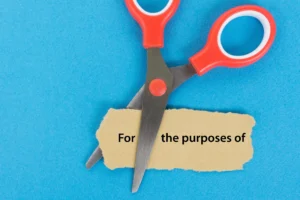
Choose a single word instead of multiple. For example, for the purposes of → for.
Use contractions if they’re appropriate and won’t place unnecessary strain on your readers to figure out what they mean. For example, cannot → can’t (unless it’s part of your humorous blog title that references a 1990s song).
In the wise words of Ernest Gowers, author of The Complete Plain Words, ‘Be short, be simple, be human.’Want a list of shorter, simpler and more human alternatives to use at work? Or help communicating concisely? Contact us for plain language training.